Davidson County, Tennessee · 2026 election cycle
The Candidate and Super Volunteer Quick Book
A resource guide for aspiring public servants and community leaders: how Metro is put together, what every elected office actually does, when each seat opens, how to file, and how to be useful before your name is on a ballot.
Getting started
How Metro is organized
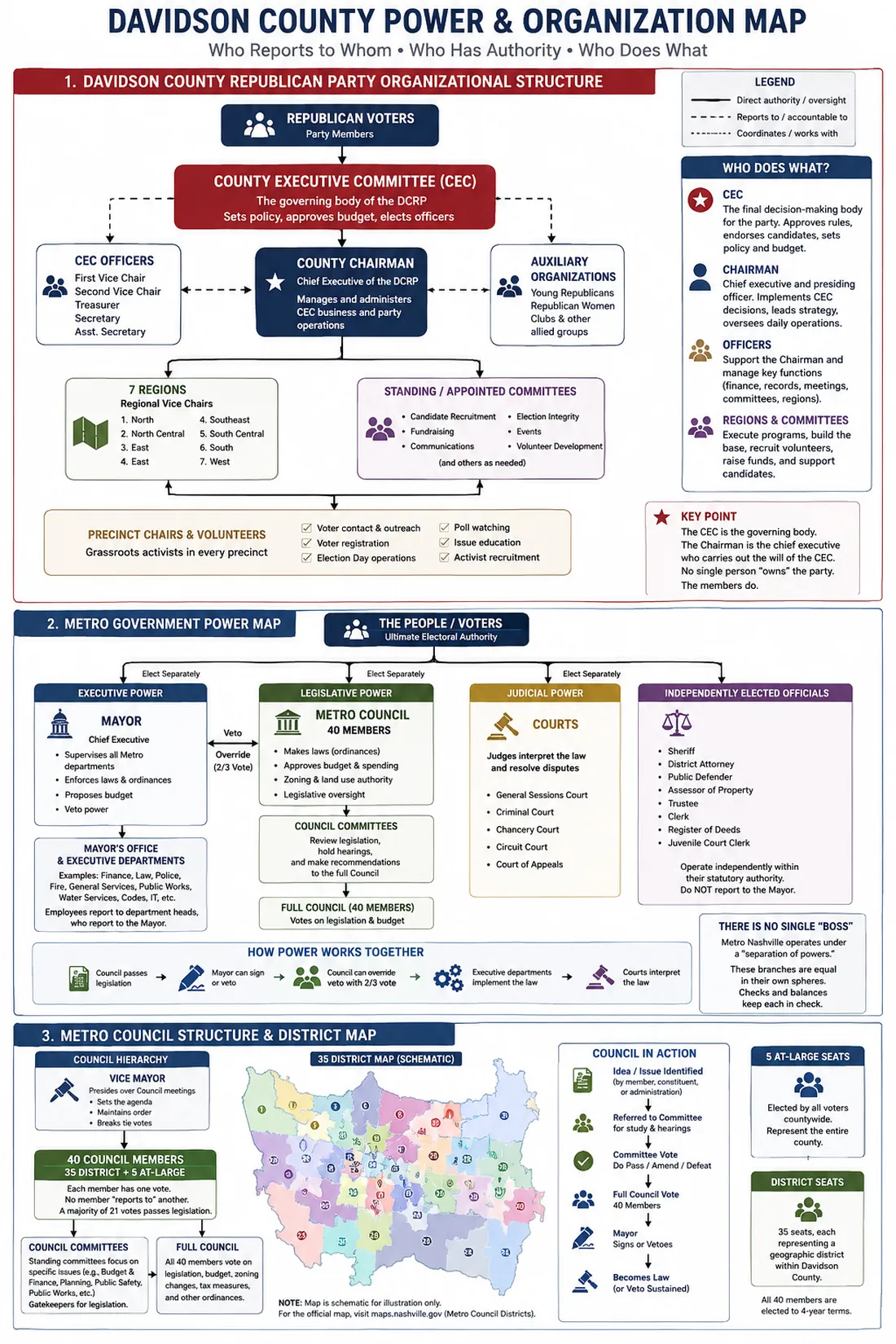
Davidson County operates under a consolidated city-county government called the Metropolitan Government of Nashville and Davidson County. City and county offices are unified under “Metro Government,” meaning most local offices are countywide or district-based Metro positions.
The three branches of Metro Government
Legislative branch: Metro Council
The Metro Council is the legislative branch. It passes ordinances, sets budgets, and approves major decisions. The Council has 40 members, 35 district seats and 5 at-large, with a Vice Mayor presiding.
Executive branch: Mayor and Vice Mayor
The Executive Branch comprises the Mayor and Vice Mayor, independently elected, functioning in an administrative and veto capacity to the Metro Council. The Executive Branch serves as chief executive of the entire county and city; proposes budgets, enforces laws, and oversees departments; and can veto Council legislation.
Judicial branch: Metro Courts
The Metro Courts include General Sessions judges, Criminal Court judges, and Circuit and Chancery Court judges.
Independently elected countywide officials
These positions operate independently from Metro as outlined in their enabling ordinances and statutory roles:
- Sheriff (runs the jail, not Metro Police)
- District Attorney (prosecutor)
- Public Defender
- Assessor of Property
- Register of Deeds
- County Clerk
- Trustee (tax collection)
- Criminal Court Clerk and Circuit Court Clerk
Departments, boards and commissions
Departments and semi-independent boards under the Executive Branch, funded and governed by the Metro Council, include the Metro Police Department, the Planning Department and Planning Commission, the school system (Metro Nashville Public Schools), the Health Department, Public Works, Parks and others. Independent boards and commissions, often appointed by the Mayor or Council, include the Planning Commission, Zoning Appeals Board, Beer Board, Hospital Authority and Airport Authority.
Smaller municipalities within Davidson County
- Belle Meade
- Forest Hills
- Berry Hill
- Oak Hill
- Goodlettsville
Offices voted on by Davidson County residents
- District Council Member (represents your specific district)
- At-Large Council Members (represent the entire county)
- Mayor of Nashville
- Vice Mayor of Nashville
- Sheriff
- Assessor of Property
- Trustee (tax collector)
- Register of Deeds
- County Clerk
- General Sessions Judges
- Criminal Court Judges
- Circuit Court Judges
- Chancery Court Judges
- School Board
Getting started
Elected office profiles
The Metro Council is the legislative body of Nashville-Davidson County’s consolidated city-county government. It passes ordinances, resolutions, zoning changes, the annual budget, tax levies, and confirms mayoral appointments. The Council is the most common and accessible entry point for candidates into local politics. Structure: 40 total members, 35 district seats elected by voters in single-member geographic districts and 5 at-large seats elected countywide.
Mayor: countywide executive
Chief executive of Metro Government. Oversees departments, budget, policy direction, appoints department heads, and vetoes legislation. This is the only role that truly controls the entire Metro apparatus day to day.
- District
- Countywide (all Davidson County voters)
- Salary
- ~$180,000–$260,000+ (executive-level)
- Time
- Full-time (often 60+ hours a week)
- Best fit
- Executive leadership experience, strong fundraising ability, high public visibility, political coalition builder, strong public communicator
Vice Mayor: countywide legislative leader
Presides over Metro Council meetings, breaks tie votes, and influences the legislative agenda. Lower pay, but high strategic influence inside the Council.
- District
- Countywide
- Salary
- ~$25,000 a year
- Time
- ~20–30 hours a week, plus political responsibilities
- Best fit
- Consensus-builder, policy-savvy, politically connected; a hybrid political and procedural leadership role
District Council Member
Passes laws, zoning changes, and the annual budget. Strong focus on neighborhood-level issues: zoning and land use, constituent services, and local infrastructure (streets, traffic, parks, sidewalks).
- District
- Each district represents ~15,000–17,000 residents. Must live in the district.
- Salary
- ~$23,000–$27,000 a year
- Time
- Officially part-time; realistic workload 15–25 hours a week (nights and weekends for community meetings)
- Best fit
- Community-connected, policy-oriented, responsive to constituents
At-Large Council Member
Passes laws, zoning changes, and the annual budget. Strong focus on countywide policy, major budget and finance decisions, citywide strategic initiatives (housing, public safety, economic development, transit).
- District
- Elected by the entire county; represents all Davidson County residents
- Salary
- ~$25,000 a year (same as district members)
- Time
- Slightly higher time commitment due to the broader constituency
- Best fit
- Requires a countywide campaign; more policy-focused, less neighborhood-specific
General Sessions Judge
Presides over civil and criminal cases. Least political role once elected; high professional barrier: law license required.
- District
- Countywide, multiple divisions (seats)
- Salary
- ~$150,000–$200,000+
- Time
- Full-time
- Best fit
- Experienced attorney, strong temperament, detail-oriented
District Attorney General
Prosecutes criminal cases on behalf of the state. State-level authority but locally elected; very high visibility in major cases.
- District
- Davidson County = 20th Judicial District
- Salary
- ~$180K–$210K
- Time
- 50–70+ hours a week
- Best fit
- Trial lawyer, strong leadership, public safety focus
Public Defender
Provides legal defense to those who cannot afford it. Caseload pressure is intense; often less political than the DA role despite elections.
- District
- Judicial district
- Salary
- ~$150K–$190K
- Time
- 50–70+ hours a week
- Best fit
- Mission-driven attorney, high stamina, team manager
Sheriff
Runs the county jail and court security (not Metro Police). One of the most operationally demanding roles; large staff and 24/7 responsibility.
- District
- Countywide
- Salary
- ~$170K–$220K
- Time
- 50–70+ hours a week
- Best fit
- Law enforcement executive, operational leader
Assessor of Property
Determines property values for taxation. Politically sensitive: valuations directly affect taxes.
- District
- Countywide
- Salary
- ~$150K–$190K
- Time
- 40–55 hours a week
- Best fit
- Data-driven, real estate or appraisal background
Trustee
Collects and manages property tax revenue. A cash-flow role: less visible, but critical to government functioning.
- District
- Countywide
- Salary
- ~$150K–$190K
- Time
- 40–55 hours a week
- Best fit
- Finance-oriented, systems manager
School Board: Metro Nashville Public Schools
Governs school policy and superintendent oversight. High impact on education, but limited control over funding (the Council controls the budget).
- District
- 9 School Board districts, 9 elected members
- Salary
- Minimal stipend
- Time
- 15–25 hours a week
- Best fit
- Education-focused, collaborative, patient with bureaucracy
Register of Deeds
Maintains property records, deeds, and real estate transactions. Low political visibility, high institutional continuity.
- District
- Countywide
- Salary
- ~$120K–$160K
- Time
- 40–50 hours a week
- Best fit
- Administrative leader, detail-focused
County Clerk
Issues licenses (vehicle, business, marriage); a public interface office. One of the most public-facing offices, with constant constituent interaction.
- District
- Countywide
- Salary
- ~$120K–$160K
- Time
- 40–55 hours a week
- Best fit
- Customer-service oriented administrator
Criminal Court Clerk
Manages records for the criminal courts. Works closely with judges and the DA; critical for system flow.
- District
- Countywide
- Salary
- ~$120K–$160K
- Time
- 40–50 hours a week
- Best fit
- Court operations, detail management
Circuit Court Clerk
Handles civil court records and filings. Less visible than the criminal clerk but equally essential.
- District
- Countywide
- Salary
- ~$120K–$160K
- Time
- 40–50 hours a week
- Best fit
- Legal administration background
Find your Metro Council or School Board district with Metro’s district lookup (opens in a new tab). Register of Deeds, County Clerk and the court clerks are known as “General Officers” under Tennessee law.
Getting started
Time and salary by office
Time commitment by office
| Office | Commitment | Realistic weekly hours |
|---|---|---|
| Mayor | Full-time | 50–70+ hrs |
| Vice Mayor | Part-time (high visibility) | 20–30 hrs |
| Council (District) | Part-time | 15–25 hrs |
| Council (At-Large) | Part-time | 20–30 hrs |
| Judge | Full-time | 40–60 hrs |
| School Board | Part-time | 15–25 hrs |
| Assessor of Property | Full-time | 40–55 hrs |
| Trustee | Full-time | 40–55 hrs |
| Register of Deeds | Full-time | 40–50 hrs |
| County Clerk | Full-time | 40–55 hrs |
| Sheriff | Full-time (high intensity) | 50–70+ hrs |
| District Attorney | Full-time (very high intensity) | 50–70+ hrs |
| Public Defender | Full-time (very high intensity) | 50–70+ hrs |
| Criminal Court Clerk | Full-time | 40–50 hrs |
| Circuit Court Clerk | Full-time | 40–50 hrs |
Approximate annual salaries
| Office | Approximate salary |
|---|---|
| Mayor | $209,898 |
| Vice Mayor | $27,977 |
| Council Member | $25,615 |
| Judge | ~$219,000–$225,000 |
| School Board | $20,635 |
| Assessor of Property | ~$185,000 |
| Trustee | ~$185,000 |
| Register of Deeds | ~$185,000 |
| County Clerk | ~$185,000 |
| Sheriff | ~$275,000+ |
| District Attorney | ~$215,000–$225,000 |
| Public Defender | $235,000 |
| Criminal Court Clerk | ~$185,000 |
| Circuit Court Clerk | ~$185,000 |
Salaries as of September 2026. Pay for Metro’s elected officials (Mayor, Vice Mayor, Council, School Board, Public Defender) is set in Metro’s annual pay plan on the Civil Service Commission’s recommendation; under Charter § 18.05 a change takes effect at the start of the officer’s next term. The Trustee, Assessor, County Clerk, Register of Deeds and the three court clerks receive the state minimum for Davidson County’s population class (T.C.A. § 8-24-102) plus a Metro supplement. The Sheriff’s salary was reset by Council resolution RS2026-2150, effective 1 September 2026, to no less than 10% below the Chief of Police’s pay. Judges’ and the District Attorney’s salaries are set by state law and adjusted each 1 July. Confirm current figures with Metro Human Resources before publishing.
Getting started
Terms and election cycles
| Office | Term | Election cycle |
|---|---|---|
| Mayor | 4 years | 2027, 2031, 2035 |
| Vice Mayor | 4 years | 2027, 2031, 2035 |
| Metro Council Members | 4 years | 2027, 2031, 2035 |
| General Sessions Judges | 8 years | 2030, 2038 |
| District Attorney General | 8 years | 2030, 2038 |
| Public Defender | 4 years | 2026, 2030, 2034 |
| Sheriff | 4 years | 2026, 2030, 2034 |
| Assessor of Property | 4 years | 2024, 2028, 2032 ² |
| Trustee | 4 years | 2026, 2030, 2034 |
| School Board, even districts | 4 years | 2026, 2030, 2034 |
| School Board, odd districts | 4 years | 2024, 2028, 2032 |
| Register of Deeds | 4 years | 2026, 2030, 2034 |
| County Clerk | 4 years | 2026, 2030, 2034 |
| Criminal Court Clerk | 4 years | 2026, 2030, 2034 |
| Circuit Court Clerk | 4 years | 2026, 2030, 2034 |
¹ The regular judicial cycle; vacancies can create intervening unexpired-term elections. ² The Assessor follows the gubernatorial-election cycle rather than the 2026 county-office cycle.
Running
Filing and candidate links
Your primary local filing and candidate hub. This is where you physically and administratively start your campaign.
- Getting candidate packets and petitions
- Filing for local offices (county, school board, etc.)
- Reviewing candidate requirements
- Accessing election calendars and deadlines
Use the election info page for filing windows, petition issuance dates, early voting timelines, candidate lists, and ballot previews.
Important: you only get access after filing your Political Treasurer form.
- Filing campaign finance reports
- Creating your candidate finance account
- Public transparency compliance
State-level candidate authority. Required for state law requirements, nominating petitions for some offices, political party recognition rules, and official candidate guides. Some offices require filings at both the county and state level.
Understand where to file (county, state or party), petition signature requirements, and filing logistics. County and state legislative candidates must file with county election commissions and sometimes additional offices.
State campaign finance oversight. Applies especially if you raise or spend above thresholds, or run for state or certain local offices.
- State-level campaign finance reporting
- Quarterly and pre-election disclosures
- Compliance with Tennessee campaign finance law
Essential for confirming you live in the district you want to run in and for understanding your electorate.
- Checking your districts (critical for eligibility)
- Verifying voter registration
- Viewing sample ballots and polling data
Age, residency, and eligibility rules; office-specific qualifications; Metro Nashville charter requirements.
Polling and district tools, civic info and ballot education.
Getting involved
Davidson County Republican Party structure
The Davidson County Republican Party (often branded as the Nashville GOP) is organized similarly to most Tennessee county Republican parties, with authority flowing from the Tennessee Republican Party’s county-party rules and local bylaws.
Organizational overview
1. County Executive Committee (CEC)
The governing body of the Davidson County Republican Party. The CEC sets party policy and strategy, oversees candidate recruitment and support, conducts party business between membership meetings, organizes fundraising and voter-contact efforts, manages county party finances, and coordinates with the Tennessee Republican Party.
2. Officers
Day-to-day operations are handled by elected officers: Chairman, Vice Chairman, Treasurer and Vice Treasurer, Secretary / Recording Secretary, Regional Vice Chairs, and other officers authorized by the bylaws.
3. Regional Vice Chairs
Davidson County is divided into geographic regions for organizing purposes. Regional Vice Chairs recruit volunteers, coordinate precinct-level activity, assist with voter turnout, help develop future candidates, and serve as liaisons between neighborhoods and party leadership.
4. Precinct organization
At the grassroots level are precinct leaders and volunteers. Their responsibilities include door knocking, voter registration, election-day turnout operations, poll watching, and recruiting local activists.
5. State Executive Committee members
Davidson County elects members to the Tennessee Republican Party State Executive Committee (SEC). These members represent Davidson County’s legislative districts at the state level, vote on state party rules and bylaws, participate in state party leadership decisions, and serve as a bridge between local and state party organizations.
6. Committees and auxiliary organizations
Active committees include Candidate Recruitment, Fundraising, Communications, Election Integrity, Events, and Volunteer Development. The Davidson County GOP also works alongside allied organizations: Nashville Young Republicans, Tennessee Young Republicans, Republican women’s clubs, and Republican elected officials’ organizations.
Getting involved
Super Volunteer resource guide
Recommended volunteer starter pack
- Join the GOP Nashville email list
- Attend a Davidson County Republican Party meeting
- Sign up as a volunteer through GOP Nashville
- Participate in a voter-contact activity (door knocking or phone banking)
- Join Nashville Republican Women or Tennessee Young Republicans (if applicable)
- Volunteer for Election Day operations
- Become active in your precinct
- Pursue a Precinct Captain or party leadership role
Key organizations and links
The official county Republican Party organization for Davidson County. Your first stop for getting involved locally: county party meetings, volunteer activities, candidate support, voter registration, grassroots outreach, and party communications.
Davidson County’s local Young Republican chapter, focused on developing young conservative leaders in the Nashville area, with representation on the county Executive Committee.
The official state Republican Party organization: statewide campaign opportunities, volunteer training, party conventions, candidate resources, and connections across Tennessee.
Leadership development and grassroots activism for the next generation of Republican leaders; often one of the fastest paths into party leadership and campaign management.
Davidson County’s premier Republican women’s organization, founded in 1949, the oldest federated Republican women’s club in Tennessee. Monthly meetings, volunteer opportunities, candidate forums, community engagement, and leadership development.
One of the largest Republican grassroots networks in Tennessee: political education, volunteer training, candidate support, leadership development, and statewide networking.
Essential for every serious political volunteer: poll worker applications, election calendars, precinct information, candidate filing info, voter registration resources, and Election Day procedures.
Running
Voter outreach methods and strategy
For political campaigns, voter outreach methods differ in persuasion power, turnout power, cost, scalability, and ability to collect data. The most effective campaigns use multiple channels because each serves a different purpose.
Relative effectiveness ranking, local races
| Method | Persuasion | Turnout | Data | Cost | Overall |
|---|---|---|---|---|---|
| Door Knocking | ★★★★★ | ★★★★★ | ★★★★★ | $$ | Highest |
| Relational Organizing | ★★★★★ | ★★★★★ | ★★★ | $ | Highest |
| Live Phone Banking | ★★★★ | ★★★★ | ★★★★ | $$ | Very high |
| Candidate Events | ★★★★ | ★★★ | ★★★ | $$ | High |
| Text Messaging (P2P) | ★★★ | ★★★★ | ★★★ | $ | High |
| Direct Mail | ★★★ | ★★★★ | ★ | $$$ | High |
| Social Media (Organic) | ★★ | ★★ | ★★ | $ | Moderate |
| Social Media Advertising | ★★★ | ★★★ | ★★★ | $$ | Moderate |
| ★★ | ★★★ | ★★★ | $ | Moderate | |
| Petitions | ★★ | ★★ | ★★★★★ | $ | Specialized |
| Robo Calls | ★ | ★★ | ★ | $ | Low |
| Yard Signs | ★ | ★ | ★ | $$ | Low |
| Newspaper Ads | ★ | ★ | ★ | $$$ | Low |
Outreach method descriptions
Volunteers or candidates go door-to-door speaking directly with voters. Personal conversations remain the most effective voter contact method ever studied. Research consistently finds that face-to-face contact increases turnout more than nearly any other outreach method.
Best for: Local races, low-information elections, building name recognition, identifying supporters
Drawbacks: Labor intensive, requires volunteer management, difficult in rural districts
Supporters contact friends, family, coworkers, church members, and neighbors. People trust people they know more than campaigns. Examples: a church member invites the congregation to vote; a parent contacts other parents from school; a business owner contacts customers.
Best for: School board, municipal, county, and legislative races
Drawbacks: Hard to scale, hard to measure
Volunteers or paid callers contact voters. Allows campaigns to reach thousands of voters quickly.
Best for: Larger districts, follow-up to mail, early voting reminders
Drawbacks: Declining answer rates, caller ID screening
Campaigns send text messages individually or through mass texting platforms. Open rates are significantly higher than email.
Best for: GOTV, volunteer recruitment, last-minute reminders
Drawbacks: Limited persuasion value, can annoy voters if overused
Physical mail pieces sent to voters. People actually see it. Types include introduction mail (“Who am I?”), contrast mail (“Why I’m different”), endorsement mail (“Who supports me”), and GOTV mail (“Vote on Tuesday”).
Best for: Older voters, high-propensity voters, Republican primaries, non-digital audiences
Drawbacks: Expensive, no direct feedback
Collect signatures around an issue. People who sign petitions are raising their hand and identifying themselves, giving the campaign their name, address, contact info, and issue preference.
Best for: Issue-based campaigns and grassroots movements
Drawbacks: Petitions themselves rarely persuade many voters
Communicates with supporters at very low cost. Cheap and scalable.
Best for: Existing supporters
Drawbacks: Low open rates, weak persuasion effect
Organic social media (Facebook, Instagram, X, TikTok, YouTube) builds familiarity, narrative control, and event promotion. Paid social media offers extremely precise audience targeting.
Best for: Organic: building familiarity. Paid: younger voters, issue advocacy, candidate introduction
Drawbacks: Organic reach is limited; paid can become expensive if poorly targeted
Town halls, meet-and-greets, house parties, church visits, and civic club meetings. Used for relationship building, volunteer recruitment, fundraising, and persuasion.
Best for: Local races
Drawbacks: Limited scale
Free coverage via local TV interviews, radio appearances, newspaper stories, and podcasts. Third-party validation is powerful.
Drawbacks: You do not control the message completely
Display ads, streaming TV ads, YouTube ads, and search ads. Used for name recognition, persuasion, and reinforcement.
Best for: Medium-sized and large districts
Drawbacks: Rarely effective alone
Show visible support. Used for name recognition and social proof. Research shows minimal direct persuasion effect.
Best for: Small local races
Automated recorded calls. Used for election reminders and endorsement announcements. Most voters ignore them.
Best for: Very large voter universes
Recommended outreach mix by campaign size
| Method | Allocation |
|---|---|
| Door Knocking | 50% |
| Relational Organizing | 20% |
| Text Messaging | 10% |
| Events | 10% |
| Social Media | 10% |
| Method | Allocation |
|---|---|
| Door Knocking | 35% |
| Phone Banking | 20% |
| Direct Mail | 15% |
| Text Messaging | 10% |
| Social Media | 10% |
| Events | 10% |
| Method | Allocation |
|---|---|
| Door Knocking | 25% |
| Direct Mail | 20% |
| Phone Banking | 15% |
| Text Messaging | 15% |
| Digital Ads | 15% |
| Social Media | 10% |
Core campaign sequence
The most successful local campaigns generally follow this sequence:
- Identify voters: petitions, events, social media, canvassing
- Persuade voters: doors, phones, mail, digital ads
- Collect data: doors, phones, petitions
- Mobilize supporters: texts, calls, GOTV mail, relational organizing
- Turn them out: door knocks, texts, calls, rides to polls
Policy
Metro policy points
As you begin to get more heavily involved in affecting our local political landscape, you will be immersed in policy. While many turn their eyes and minds to state and national policy, some of the policy that affects us most is local policy. Here is a quick introduction to the 2026 landscape of policy issues and the key local political players that influence whether that policy gets put into practice.
Nashville Metro Government snapshot: the biggest political battles brewing
Despite the Growth Coalition’s dominance of certain policy points, several major conflicts are emerging. These battles will shape Nashville politics over the next decade.
Metro Government vs. Tennessee state government
A major structural conflict between the state’s priorities and the county’s agenda. The Republican-controlled state legislature has repeatedly intervened in Nashville’s governance. The broader conflict includes disputes over tax authority, stadium financing, transportation funding, and public school budgets.
Development vs. affordable housing
This is becoming the central political divide in Nashville. Rapid growth has dramatically increased housing prices. Advocacy groups such as Stand Up Nashville and various neighborhood associations argue that development incentives have benefited investors while leaving working residents behind. Major debates have focused on density metrics, “inclusive” zoning, major corporate land grabs, workforce housing needs, and tax incentives for developers.
Transportation infrastructure
Traffic congestion is one of the city’s biggest challenges. The Mayor’s initiatives aim to expand transit, sidewalks, and bus systems. Questions revolve around how to fund transit, sales tax increases, bus versus rail priorities, and suburban commuter access.
East Bank redevelopment
The massive redevelopment around the Cumberland River near the Titans stadium is one of the largest urban planning projects in Tennessee history. Political fights involving land use, public subsidies, infrastructure costs, and affordable housing needs erupt in the halls of local government frequently.
Growth vs. neighborhood preservation
Rapid redevelopment in historic neighborhoods has triggered much conflict. Neighborhood groups are increasingly organized and politically active. Key flash-points include rezoning battles, demolition of historic properties, short-term rental regulations, and historic preservation regulations.
The core political divide in the Metro Council (two axes)
Nashville’s Council politics is dominated by land use. Housing density debates have become the central political dividing line, while zoning and planning decisions divide the Council most sharply. Axis A is the housing vs. development battle, with a majority supporting an urbanist, pro-growth outlook and the opposition siding with a neighborhood-protection, slow-growth framework. Axis B is the governance and fiscal divide: progressive spending dominates while fiscal conservatives and big-government skeptics take a back seat, often becoming agenda skeptics rather than agenda setters.
Key Metro Council voting coalitions
The urbanist / pro-growth coalition
Roughly 12–16 reliable votes depending on the issue, felt mainly in planning and transit measures. These members generally support major rezoning, like the Nations plan, aimed at increasing density and walkability, and usually form the majority base for land-use legislation. Key issues: zoning reform (duplexes, triplexes, NEST planning), transit expansion, East Bank redevelopment, urban density around job centers, and residential housing density. Zoning reform proposals to allow duplexes and more housing types are led by council members such as Quin Evans Segall and Rollin Horton.
The neighborhood protection / slow-growth coalition
Roughly 8–12 votes depending on zoning cases, with veto power on zoning issues: this group can block rezoning attempts, especially when district council members control local land-use decisions, and usually forms the core opposition on development bills. Key issues: opposition to density in single-family neighborhoods, development impact concerns, historic preservation and neighborhood planning, zoning limits, and overdevelopment. Rezoning efforts such as the Nations development plan sparked strong neighborhood backlash. Council members Jeff Eslick and Joy Kimbrough spoke against housing-density legislation in council debate.
The progressive governance coalition
Roughly 8–12 reliable votes, with heavy influence on budget and social policy. This coalition overlaps heavily with the urbanists but emphasizes an equity framing rather than a growth framing. Key issues: affordable housing programs, social services funding, public transit, and labor protections.
The fiscal conservative / government skeptic bloc
Roughly 6–8 reliable votes, focused on budget and spending. Not a hard ideological bloc, but often aligned on budget oversight: budget discipline, infrastructure spending, transparency, and skepticism toward large projects. Council member Courtney Johnston has consistently pushed transparency measures around city utilities and contracts.
The leadership coalition
These members wield procedural and committee power rather than ideological cohesion, and often determine what legislation advances regardless of ideology. Key institutional members: Kyonzte Toombs (budget and finance), Delishia Porterfield (senior leadership), Quin Evans Segall (infrastructure and development), Clay Capp (charter and planning), Rollin Horton (zoning authority).
The swing bloc
Even though the Council has 40 members, the effective decision-making group in close votes is usually 15–20 members. Most legislation passes with comfortable margins because the body leans left. High-stakes votes have included budget amendments, major rezoning, policing funding, tax changes, stadium financing, and transit policy. A small swing coalition of about 10 members often determines the outcomes: members who sit between the progressive bloc (about 22 members) and the small conservative minority (3–4 members), vote case by case, negotiate amendments, and often determine whether a vote ends 23–17 (passes) or 19–21 (fails). They tend to evaluate legislation on neighborhood impact, fiscal cost, developer involvement, and pressure from the Mayor’s office.
Where the swing coalition matters most
- Rezoning and development: major housing or mixed-use rezonings frequently pass 22–18 or 23–17. Key swing voters: Rollin Horton, Mike Cortese, Clay Capp.
- Budget amendments: the Mayor submits the budget, but the Council tweaks it. The central negotiator is Kyonzte Toombs, chair of the Budget and Finance Committee.
- Policing and public safety: votes on police funding or policy reforms split the Council. Key moderator: Jordan Huffman.
- Transit spending: transit expansion is popular but expensive. Swing vote: Thom Druffel.
If you have more questions about the policy points above or want to try developing a few policy points of your own for your own candidacy, contact Spencer Anastasio at spencer.anastasio@gopnashville.org.
Policy
Saving Nashville’s music
One of the most essential communities in Davidson County is our musician community. Nashville is Music City. Nashville’s music culture is what inspires individuals from around the world to visit, men and women from across the country to move to pursue their dreams, and residents to enjoy an incredible artistic and musical culture distinctly its own. When we think of policy, it is important to think of how we can protect Nashville’s historical musical heritage. These policy points, incorporated by request of the Music Venue Alliance Nashville, are ideas for emerging candidates to consider adopting in their platform as they run their race.
Saving Nashville’s music and music history
Preserve Music City
- Create a Cultural Land Trust to preserve historic music venues, rehearsal spaces, recording studios, and creative properties threatened by redevelopment.
- Ensure East Bank development includes below-market-rate opportunities for locally owned independent music venues, creative businesses, and cultural organizations.
Support the creative workforce
- Financially support the Tennessee Live Music Fund to protect and grow Nashville’s network of independent venues, recognizing their role as the farm system for artists, songwriters, and the broader music economy.
- Invest 1% of the Metro budget in community via music, arts, and entertainment.
- Address musician and venue parking concerns through Metro’s street parking and transportation programs.
- Expand affordable workforce housing solutions that serve musicians, artists, venue workers, and creative entrepreneurs.
Create a seat at the table
- Invest in the continued growth of the Office of Entertainment, or establish an official advisor dedicated to representing the needs of Nashville’s creative community within Metro government.
- Hire local talent to perform at the start of every Metro Council meeting.
Invest in music as economic development
- Create new economic development incentives that benefit Nashville’s creative community, independent venues, music businesses, and live entertainment sector.
- Incorporate music and culture into neighborhood planning, tourism strategy, and economic development initiatives.
- Recognize music as critical infrastructure that drives jobs, tourism, small business growth, and quality of life.
Getting involved
Candidate and volunteer punch card
Sixteen punches. Candidates and super volunteers who complete this card will be invited to a special dinner and ceremony at the end of the year and will be up for consideration for special candidate and super volunteer development support from GOP Nashville.
Help
Contact
If you have any questions, concerns, or if you think of any helpful additions to this Quick Book, please contact the founder of Citizen Activate, Elle Johnson, at go@citizenactivate.com.
Davidson County · Citizen Activate 2026 · Candidate resource. Figures are approximate and subject to change; check Metro Nashville and Davidson County official sites for current numbers.